Free download · PDF, Excel and PowerPoint
The Alder Ridge Review
What a church's giving records say about its people.
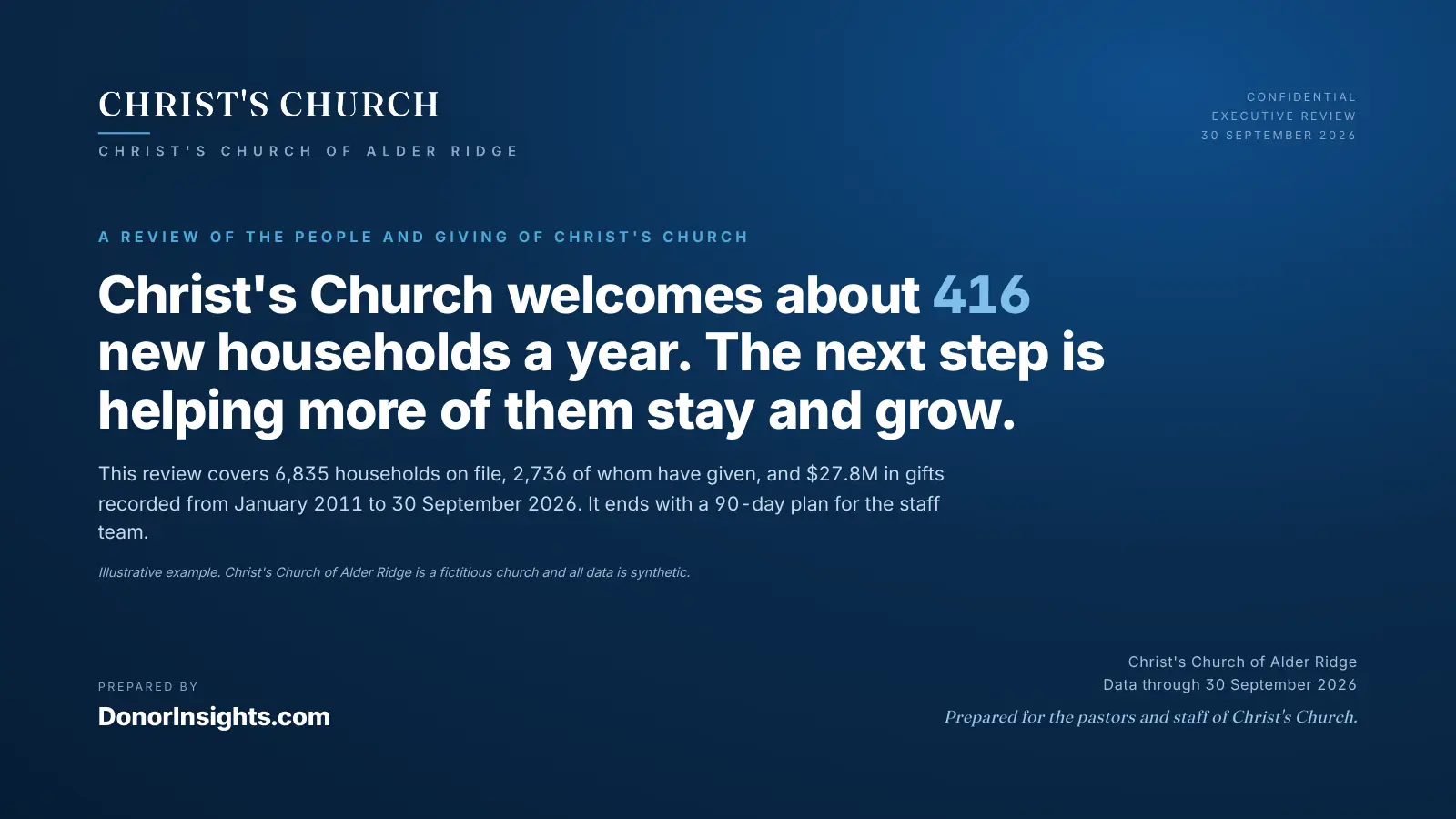
An illustrative church health review for Christ's Church of Alder Ridge, a fictitious church built from synthetic records.
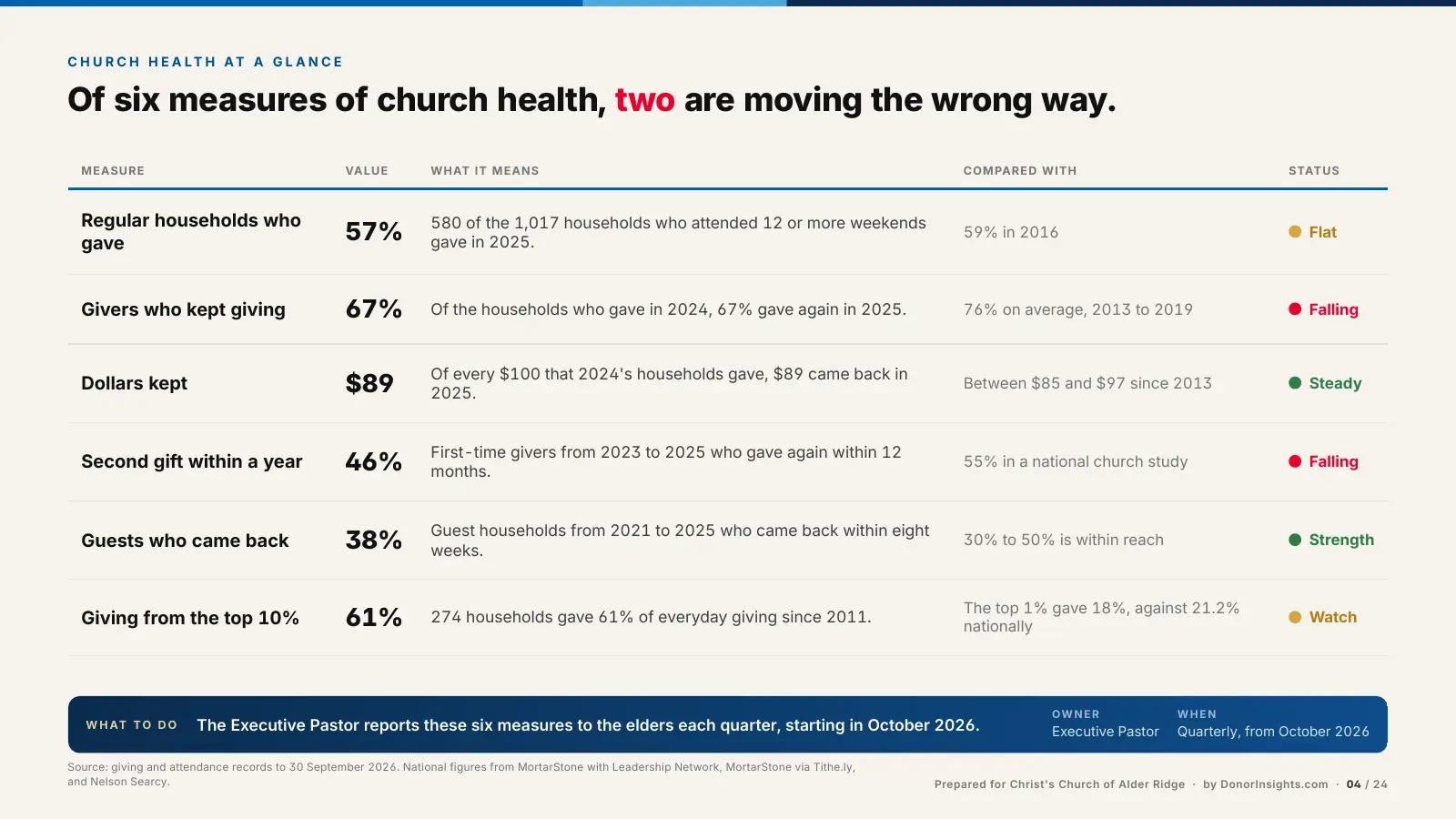
Guests, first-time givers, households who drifted and households ready for a next step, read from one church's records. The executive review is for the elders and the staff. The workbook holds every number and the lists a team can call from. The slide deck is the review again, ready to edit.
Get the Alder Ridge Review
We use your name and email to send you the files and the download links. Privacy Policy.
Illustrative example. Christ's Church of Alder Ridge is a fictitious church and all data is synthetic. The structure, the methods, and the way the findings are presented are what we prepare for a real church.
What you get
Three files, one church, one set of numbers.
Each file serves a different room. The figures match across all three, so the elders, the staff and the person keeping the books all work from the same story.
PDF · 24 pages
Executive review
The review for the elders and the staff. Each page leads with what it found, and the review ends with a 90-day plan.
Excel · 24 tabs
Church health workbook
The numbers behind every page, a planning model, and two ranked lists of 100 households with a suggested next step for each.
PowerPoint · 24 slides
Editable slide deck
The same review as editable slides with speaker notes, ready for a staff meeting or an elder board.
Who it is for
A finished review to put in front of the people you serve with.
Read it as the review a church receives at the end of a real engagement, whether you lead a church or you serve churches.
01
Senior and executive pastors
See where people find the church, where they settle in, and where they quietly drift. Each finding ends with a next step, an owner and a date.
02
Elder and finance teams
Present the editable deck as it stands. Each slide states its point in the headline, so the room reads the argument at a glance.
03
Connections and groups staff
Work the two ranked lists of households. Each row carries a reason in plain words and a suggested next step, with care first and no ask for people who still attend.
04
Those who serve churches
The workbook keeps a methodology tab and live formulas, so every headline traces back to the records it came from.
Inside the review
A finding on every page, and a plan at the end.
The review follows people from their first visit to a settled place in the church, and ends with the next 90 days. The figures below are the fictitious church's synthetic numbers, taken straight from the review.
Section 02
Welcoming new people
How many guests come, how they first came, and how many come back.
48%of guests invited by a friend came back, against 20% of guests who first came on Christmas Eve
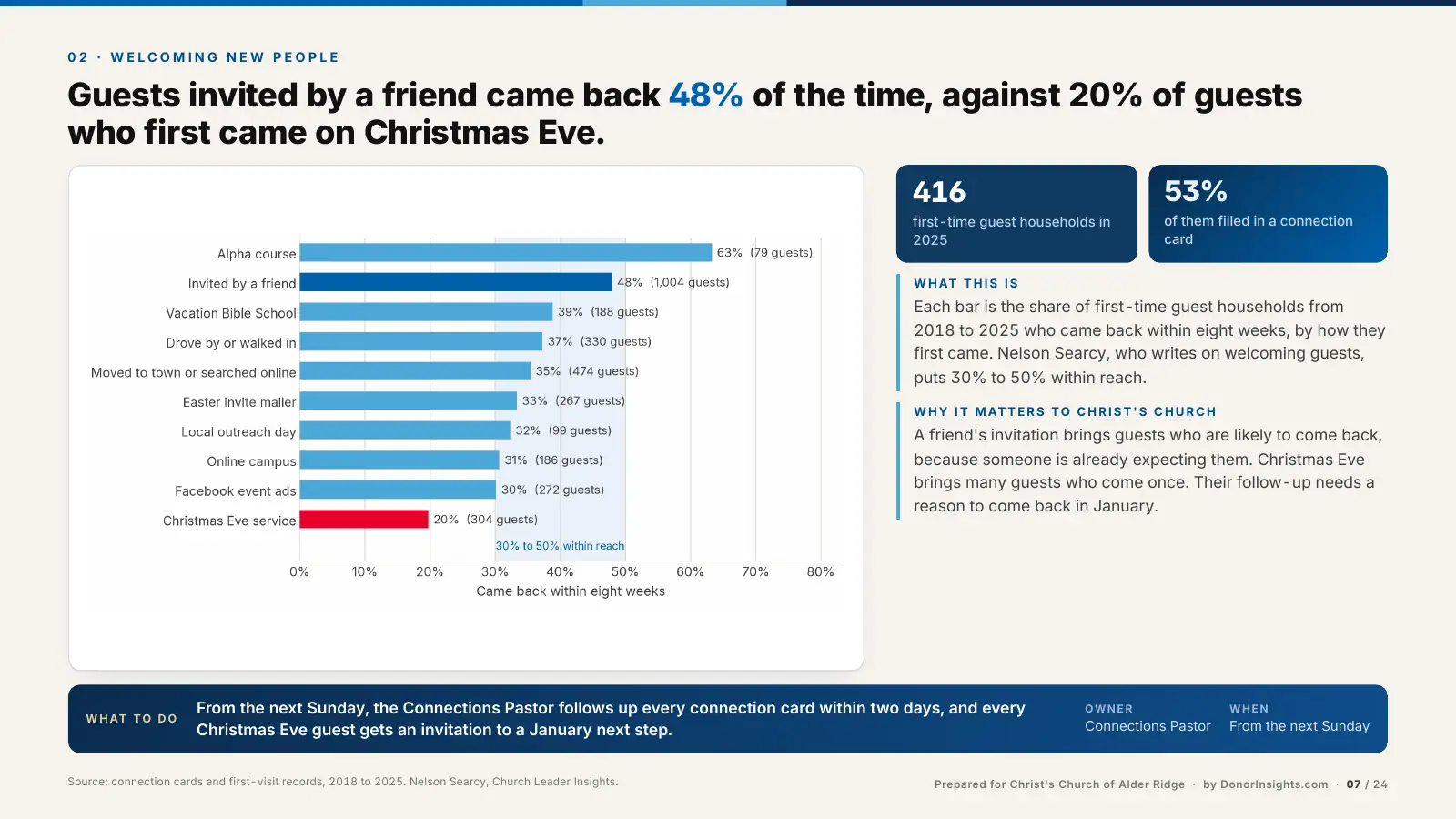
p. 07Welcoming new people. Guests invited by a friend came back 48% of the time. Section 03
First-time givers and the second gift
How soon first-time givers give again, and what that second gift is worth over five years.
46%of first-time givers from 2023 to 2025 gave again within a year, down from 69% in 2013 to 2015
Section 04
Helping people stay
How many giving households give again each year, and what being in a group has to do with it.
77%of givers in a group or class kept giving in 2025, against 38% of givers who were not connected
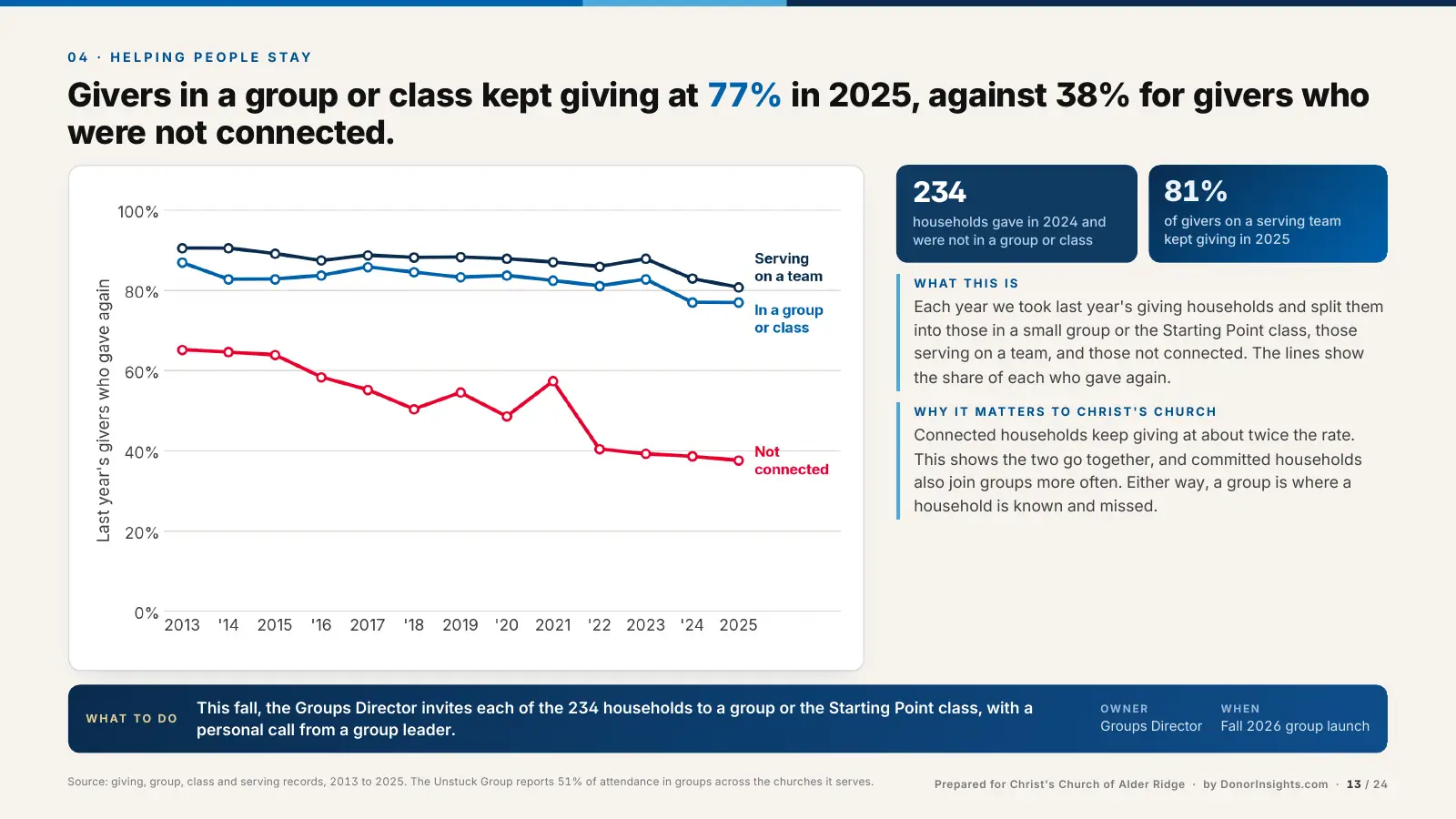
p. 13Helping people stay. Givers in a group keep giving at about twice the rate. Section 07
People who have drifted
When a household that stopped giving is still likely to return, and who to reach first.
33%of households 13 to 15 months past their last gift give again within a year. By 25 to 27 months, 14% do.
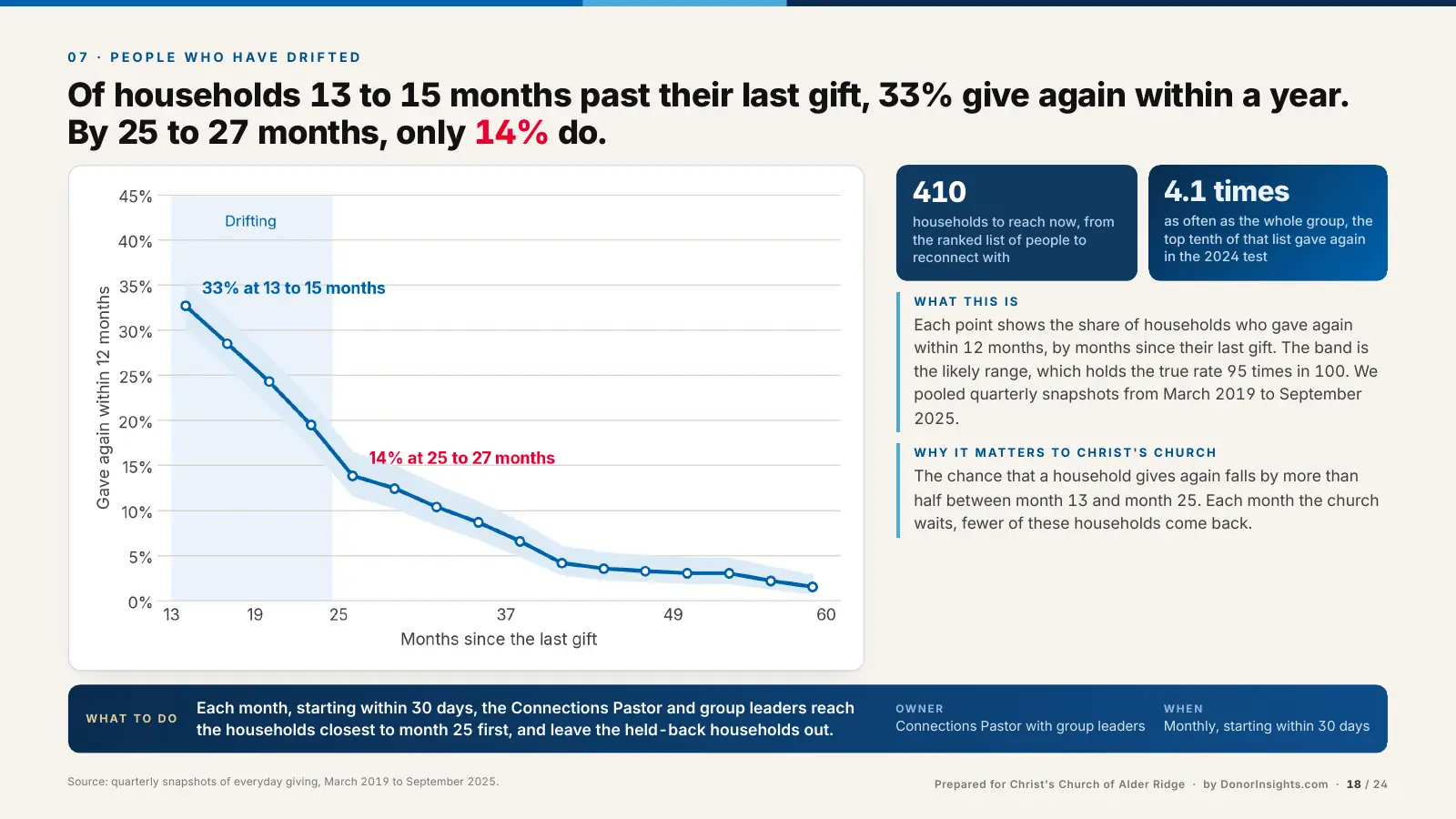
p. 18People who have drifted. The chance of return halves between month 13 and month 25. Section 09
The two ranked lists
Which households to reconnect with, which are ready for a next step in generosity, and how the lists were tested.
100households on each of two ranked lists, both tested on 2024 results before anyone used them
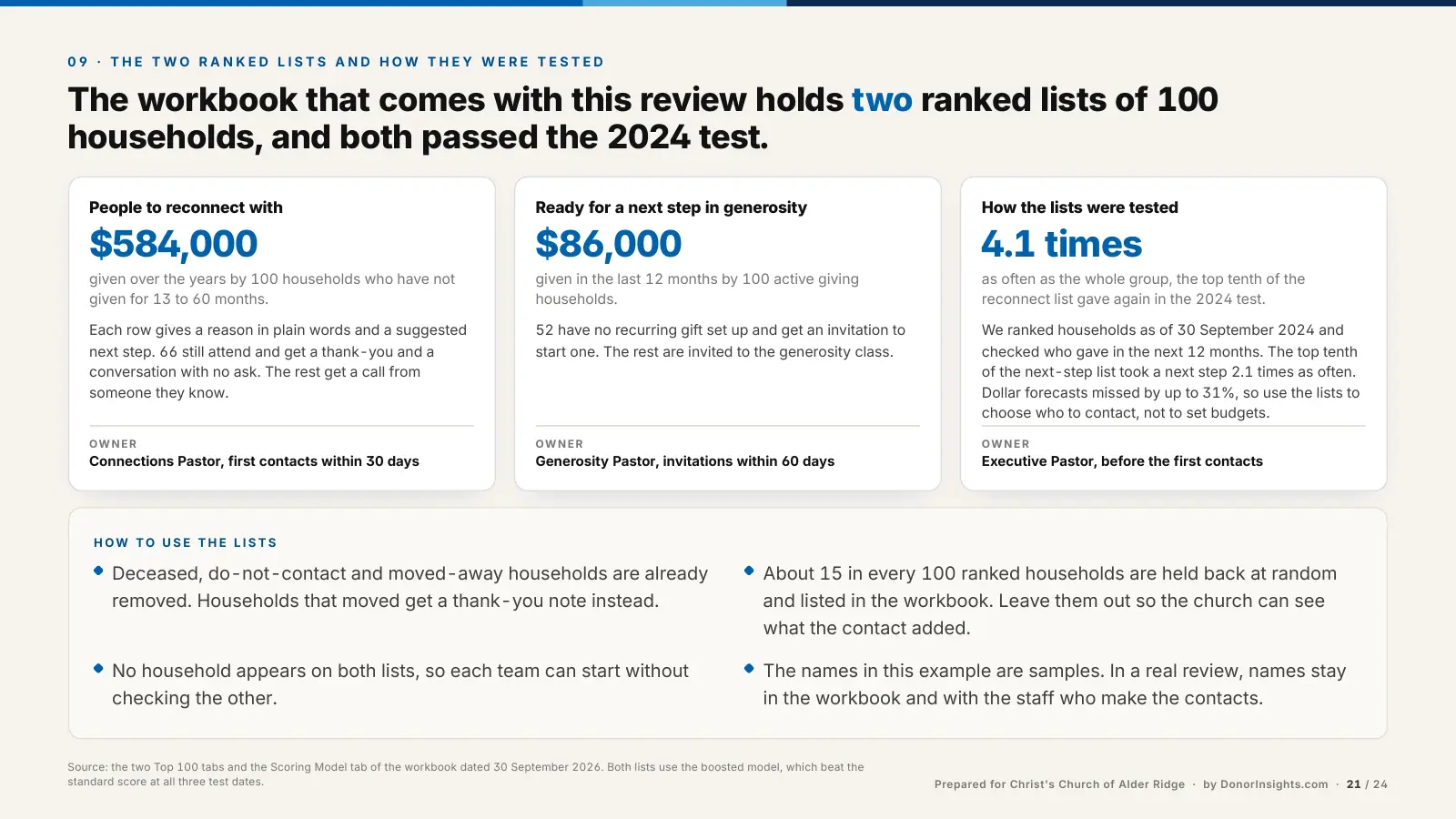
p. 21The two ranked lists, and how they were tested. Section 11
The 90-day plan
What happens next, who on staff owns each step, and how the church will know it worked.
7steps over 90 days, each with an owner and a date
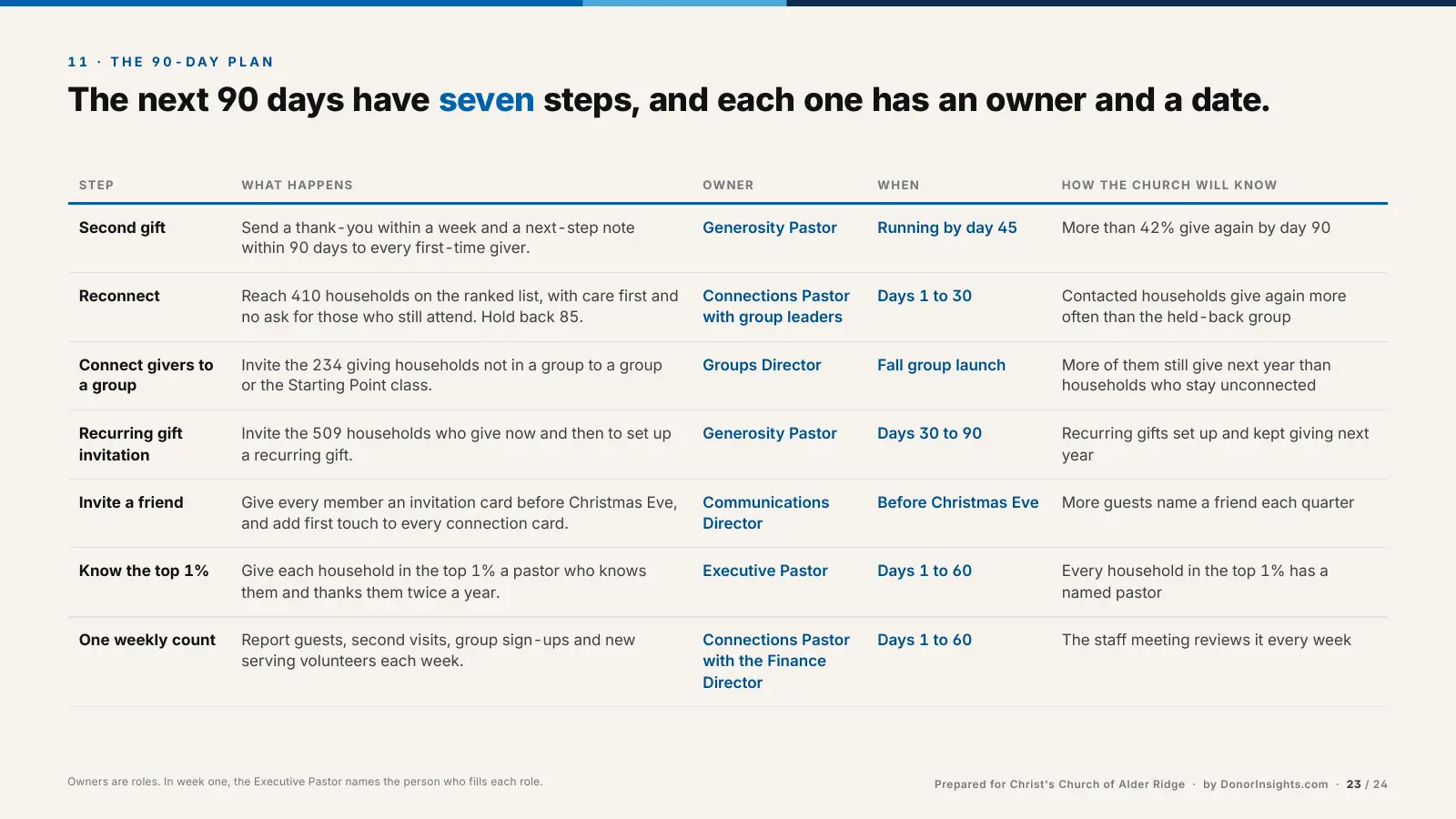
p. 23The 90-day plan. Seven steps, each with an owner and a date.
Six of the 24 pages are shown here. The rest, the workbook, and the slide deck arrive when you submit the form. Get all three files
What a review surfaces
Connected households keep giving.
At the fictitious Christ's Church, givers in a group or the Starting Point class kept giving at 77% in 2025. Givers who were not connected kept giving at 38%.
Giving records are a quiet sign of belonging. The review names the 234 giving households who are not yet in a group, and puts a personal invitation from a group leader in the plan.
38%
of givers who were not in a group or class kept giving in 2025
Synthetic figures for a fictitious church.
How it is made
One output of an always-on platform.
The Alder Ridge Review is what the platform produces from a church's giving, attendance and connection records, read into a review the elders can act on and lists a team can call from. The platform runs every day. The review is the moment it is written down.
Works with your church software
Giving and people records come in from the system the church already uses. No re-keying, no exports by hand.
Read pastorally
The words are the church's words: guests, first-time givers, giving households, next steps. Care comes before any ask.
Numbers you can trust
Every figure traces back to the church's own records, and the review says plainly what the records cannot yet tell you.
Get the Alder Ridge Review.
The executive review, the workbook, and the editable deck, free. Read them as the review your church could receive.
Illustrative example. Christ's Church of Alder Ridge is a fictitious church and all data is synthetic, built to show the shape of a real review without describing any real church.